
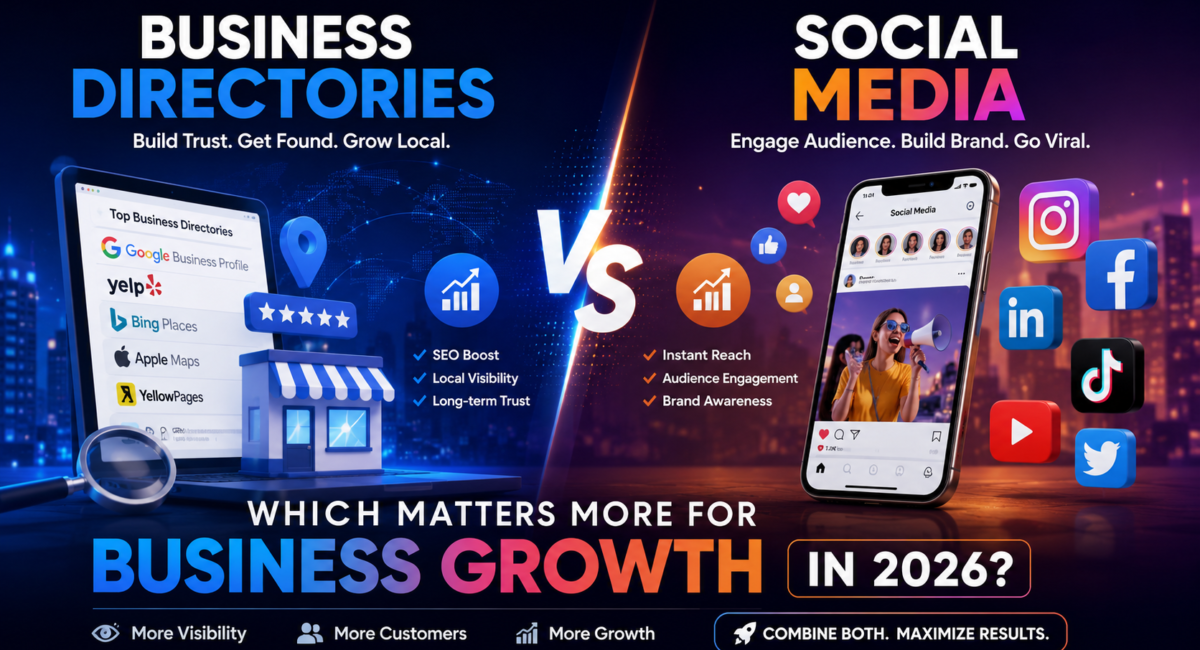
Business Directories vs Social Media: Which Matters More for Business Growth in 2026?
Imagine you’re looking for the best digital marketing agency, restaurant, gym, or salon in your city.
What would you do first?
Most people open Google and search for terms like “best digital marketing agency near me” or “best café near me.” Others may discover businesses through Instagram Reels, Facebook posts, or LinkedIn recommendations before deciding to buy.
This simple customer behavior highlights an important truth:
Business directories and social media influence customers at different stages of their buying journey.
Yet many business owners continue asking the same question:
Which is better for business growth—Business Directories or Social Media?
The answer isn’t as simple as choosing one over the other.
Business directories help people find your business when they are actively searching for a product or service. Social media, on the other hand, helps people discover your brand, engage with your content, and build trust over time.
In our experience working with businesses focused on improving their online presence, we’ve seen that companies relying only on social media often miss valuable local search traffic. Likewise, businesses that only optimize directory listings may miss opportunities to build lasting relationships with potential customers.
The businesses that consistently grow are those that understand how these two channels complement each other rather than compete.
In this detailed guide, you’ll learn:
- What business directories are
- How social media differs from business listings
- Which platform is better for SEO
- Which one generates better leads
- Their advantages and disadvantages
- Common mistakes businesses make
- How to combine both for maximum growth in 2026
By the end of this article, you’ll know exactly where to focus your time, budget, and marketing efforts based on your business goals.
Why Your Online Presence Matters More Than Ever
A few years ago, simply having a website was enough for many businesses.
Today, that’s no longer the case.
Customers don’t just visit websites—they compare businesses, read reviews, explore social media profiles, check ratings, and evaluate credibility before making a decision.
Whether you’re a local service provider, an eCommerce brand, or a growing startup, your online presence directly impacts how people perceive your business.
A strong online presence helps you:
- Build trust with potential customers.
- Improve visibility in search results.
- Generate qualified leads.
- Increase website traffic.
- Strengthen your brand reputation.
- Stay competitive in your industry.
This is where business directories and social media both play significant roles—but in very different ways.
Understanding the Modern Customer Journey
Before comparing business directories and social media, it’s important to understand how customers make buying decisions today.
A typical customer journey often looks like this:
Stage 1: Awareness
The customer discovers a problem or need.
For example:
“I need a nearby digital marketing agency.”
At this stage, they might see:
- Instagram posts
- Facebook ads
- LinkedIn articles
- YouTube videos
or
Search directly on Google.
Stage 2: Research
Now they begin comparing businesses.
They usually check:
- Reviews
- Ratings
- Website
- Portfolio
- Social media pages
- Business listings
Trust becomes extremely important here.
Stage 3: Decision
Finally, they contact the business.
Most users choose companies that:
- Have positive reviews.
- Provide complete business information.
- Respond quickly.
- Look trustworthy online.
Notice something?
Business directories and social media both influence the customer’s decision—but at different moments.
That’s why comparing them isn’t about finding a winner.
It’s about understanding their roles.
What Are Business Directories?
Business directories are online platforms where companies create public profiles containing essential business information.
Think of them as modern digital versions of traditional business directories—but far more powerful.
A typical business listing includes:
- Business Name
- Address
- Phone Number
- Website
- Working Hours
- Categories
- Photos
- Customer Reviews
- Services Offered
- Google Maps Location
These platforms help customers discover businesses based on location, category, or specific search queries.
Unlike social media, users visiting business directories usually have a clear intent—they’re actively looking for a product or service.
That makes business directories one of the most valuable sources of high-intent traffic.
Why Business Directories Are Important
Many people believe directories are becoming outdated.
The reality is the opposite.
Search engines continue to rely on trusted business listings to verify a company’s legitimacy.
When your business information is consistent across multiple trusted directories, search engines gain confidence that your business is authentic and reliable.
This consistency contributes to:
- Better Local SEO
- Higher trust signals
- Improved search visibility
- Increased customer confidence
- Stronger online authority
For local businesses, accurate directory listings can significantly improve discoverability when people search for nearby services.
Key Features of Business Directories
Business directories offer several features that help customers evaluate a business quickly.
These commonly include:
Business Information
Customers can instantly find:
- Phone number
- Address
- Website
- Opening hours
Without needing to visit multiple platforms.
Customer Reviews
Reviews influence purchasing decisions.
Positive customer experiences help build trust before someone even contacts your business.
Maps & Directions
Location-based businesses benefit from integrated maps, making it easier for customers to visit physical stores or offices.
Categories
Businesses are grouped by industry, making discovery easier.
For example:
- Restaurants
- Digital Marketing Agencies
- Hospitals
- Gyms
- Hotels
- Educational Institutes
- Salons
Website Links
Most directories allow businesses to link directly to their websites, creating additional referral traffic opportunities.
Popular Business Directories Businesses Should Consider
Although Google Business Profile remains one of the most influential business listing platforms, businesses can strengthen their online presence by maintaining accurate information across multiple trusted directories.
Some well-known examples include:
- Google Business Profile
- Yelp
- Bing Places
- Apple Maps
- Justdial
- IndiaMART
- Sulekha
- Yellow Pages
- Facebook Business Pages
The goal isn’t simply to appear on many directories—it’s to ensure that your business information remains accurate and consistent everywhere customers might find you.
What Is Social Media Marketing?
While business directories help customers find your business, social media helps customers connect with your brand.
Social media marketing involves using platforms such as Facebook, Instagram, LinkedIn, X (formerly Twitter), YouTube, and Pinterest to build awareness, engage audiences, and promote products or services.
Unlike directories, social media isn’t just about displaying information.
It’s about creating conversations.
Businesses use social media to:
- Share educational content
- Post updates
- Launch new products
- Publish videos
- Showcase customer success stories
- Answer questions
- Build communities
- Increase brand awareness
- Generate leads through paid and organic campaigns
Instead of waiting for customers to search for your business, social media enables you to reach potential customers through engaging content and targeted advertising.
How Social Media Influences Buying Decisions
Today’s customers rarely purchase from a business they’ve never heard of.
Instead, they often spend time exploring a company’s online presence.
They may:
- Watch Instagram Reels.
- Read LinkedIn posts.
- Browse Facebook reviews.
- View YouTube tutorials.
- Check customer comments.
- Compare engagement levels.
Every interaction builds familiarity.
Over time, this familiarity develops into trust.
When customers are finally ready to buy, they’re more likely to choose a business they’ve already seen, followed, or interacted with online.
This makes social media an essential channel for long-term brand building rather than immediate customer discovery.
Business Directories vs Social Media: Understanding the Fundamental Difference
Although both platforms improve your online presence, they serve completely different purposes.
Think of it this way:
| Business Directories | Social Media |
|---|---|
| Help customers find your business | Help customers remember your business |
| Improve Local SEO | Improve Brand Awareness |
| Focus on business information | Focus on content and engagement |
| High purchase intent | Discovery and relationship building |
| Driven by search | Driven by algorithms and content |
| Builds trust through reviews | Builds trust through interaction |
| Stable long-term visibility | Requires consistent activity |
This difference explains why successful businesses rarely choose one over the other.
Instead, they integrate both into a unified digital marketing strategy.
Business Directories vs Social Media: Which One Generates Better Leads?
One of the biggest misconceptions is that every lead has the same value.
In reality, the quality of a lead often depends on where that person is in the buying journey.
Someone searching for a business on a directory usually has a specific need and is ready to compare options. These users often have higher purchase intent because they are actively looking for a solution.
On the other hand, a person who discovers your brand through social media may not be ready to buy immediately. They might first engage with your content, follow your page, or watch your videos. Over time, as trust grows, they become more likely to convert into a customer.
This means that business directories often generate high-intent leads, while social media plays a crucial role in nurturing and influencing future customers.
Benefits of Business Directories for Business Growth
Many businesses create a listing on a business directory and never update it again. That’s a missed opportunity. A well-optimized business listing can become one of your most valuable digital assets, especially if you serve customers in a specific city or region.
Let’s explore why business directories continue to play a vital role in 2026.
1. Improve Local SEO Visibility
One of the biggest advantages of business directories is their contribution to Local SEO.
When someone searches for:
- Best digital marketing agency near me
- Coffee shop in Kolkata
- Dentist near me
- SEO company in Delhi
Search engines analyze several trust signals before deciding which businesses to display.
A consistent business listing across trusted directories strengthens these signals.
Important factors include:
- Business Name
- Address
- Phone Number (NAP)
- Website URL
- Business Category
- Customer Reviews
The more consistent your information is, the easier it becomes for search engines to trust your business.
2. Increase Business Credibility
Imagine two businesses offering the same service.
Business A
- Complete business profile
- High-quality photos
- Updated contact details
- 150 positive reviews
- Verified listing
Business B
- No reviews
- Incomplete information
- Outdated phone number
Most customers will naturally trust Business A.
Your directory profile acts like a digital first impression.
A complete listing communicates professionalism and reliability before a customer even visits your website.
3. Attract High-Intent Customers
Business directories attract people who are already searching for a solution.
For example:
Someone typing:
“Best web development company near me”
is far closer to making a purchasing decision than someone casually scrolling through Instagram.
This is why directory traffic often converts better than general social traffic.
4. Improve Online Reputation
Customer reviews have become one of the strongest trust factors online.
Positive reviews help potential customers feel more confident about choosing your business.
Instead of only collecting reviews, businesses should also:
- Respond politely to feedback.
- Thank satisfied customers.
- Address complaints professionally.
- Resolve issues publicly when appropriate.
A business that actively manages its reviews often appears more trustworthy than one with perfect ratings but no responses.
5. Generate Referral Traffic
Many directories allow businesses to include their website link.
These links help users learn more about your products or services and can drive qualified visitors who are already interested in what you offer.
While referral traffic varies by platform, it can contribute to broader brand visibility and customer acquisition.
6. Build Trust with Search Engines
Search engines look for consistency across the web.
If your business name, address, and phone number are different on multiple websites, search engines may become less confident about your business information.
Maintaining accurate listings across reputable directories reinforces trust and supports better local search performance.
Benefits of Social Media for Business Growth
While business directories help customers discover your business, social media helps them build a relationship with your brand.
That relationship often becomes the deciding factor when customers compare multiple businesses.
1. Build Brand Awareness
People rarely purchase from a business they’ve never heard of.
Regularly publishing useful content keeps your business visible even when customers are not ready to buy.
Over time, repeated exposure increases familiarity—and familiarity builds trust.
2. Create Meaningful Customer Relationships
Unlike business directories, social media enables two-way communication.
Customers can:
- Ask questions
- Leave comments
- Share experiences
- Send direct messages
- Participate in discussions
Every interaction is an opportunity to strengthen customer relationships.
3. Showcase Expertise
Educational content demonstrates knowledge and builds authority.
Businesses can share:
- Industry tips
- Case studies
- Success stories
- Tutorials
- Frequently asked questions
- Behind-the-scenes updates
- Customer testimonials
Helpful content positions your business as a trusted source rather than just another seller.
4. Reach New Audiences
Social media algorithms often recommend content to users who haven’t interacted with your brand before.
This allows businesses to expand their reach organically through valuable and engaging posts.
Paid advertising can further increase visibility by targeting users based on interests, demographics, and behavior.
5. Encourage Customer Loyalty
Existing customers appreciate businesses that continue to educate and engage them after a purchase.
Consistent social media activity helps maintain long-term relationships and encourages repeat business.
Business Directories vs Social Media: SEO Comparison
A common misconception is that social media directly improves Google rankings.
The reality is more nuanced.
Let’s compare both channels from an SEO perspective.
| SEO Factor | Business Directories | Social Media |
|---|---|---|
| Local SEO | Excellent | Limited |
| Business Citations | Strong | Weak |
| Customer Reviews | Excellent | Moderate |
| Brand Awareness | Moderate | Excellent |
| Website Traffic | Moderate | High |
| Customer Engagement | Low | Excellent |
| Authority Building | Moderate | High (through content) |
| Long-Term Visibility | High | Depends on consistency |
Which One Is Better for Local SEO?
If your goal is to appear in location-based searches, business directories provide a stronger foundation.
They help search engines verify:
- Your business location
- Contact information
- Categories
- Customer reviews
- Local relevance
Social media supports Local SEO indirectly by increasing brand awareness and driving traffic, but it doesn’t replace accurate business listings.
Which One Is Better for Brand Building?
Brand building requires consistency, storytelling, and engagement.
This is where social media excels.
Through regular posts, videos, customer stories, and educational content, businesses can shape how customers perceive their brand over time.
Directories help people find you.
Social media helps people remember you.
Real-Life Example: How Both Channels Work Together
Imagine a local bakery opening in a busy neighborhood.
The owner creates a verified business directory listing with:
- Address
- Phone number
- Working hours
- Menu
- Photos
- Customer reviews
A customer searching “bakery near me” discovers the shop and visits.
Meanwhile, the bakery also posts short videos on Instagram showing fresh cakes, behind-the-scenes baking, and customer celebrations.
Another user discovers the bakery through social media, follows the page, and eventually visits after seeing multiple posts.
Although the discovery paths are different, both channels contribute to the same goal—bringing customers through the door.
Customer Journey: Where Each Platform Fits
Understanding customer intent is more valuable than choosing one platform over another.
Awareness Stage
The customer is not actively searching.
Social media introduces your brand through engaging content.
Consideration Stage
The customer starts researching options.
They compare businesses, read reviews, and explore websites.
Business directories become more influential here.
Decision Stage
The customer is ready to take action.
They check ratings, business information, contact details, and reviews before making a final choice.
At this stage, a complete and trustworthy directory listing can significantly influence the final decision.
Expert Insight: Stop Comparing—Start Combining
Many businesses ask:
Should I invest in business directories or social media?
A better question is:
Where is my customer in their buying journey?
If your customer is actively searching for a service, business directories are often the first point of contact.
If your customer is discovering new brands or learning about your industry, social media becomes the stronger channel.
The most successful businesses don’t choose one over the other.
They use business directories to improve discoverability and social media to strengthen relationships.
This combination creates a more resilient and effective digital marketing strategy.
Industry Insights and Consumer Trends
Digital consumer behavior continues to evolve, but a few trends remain consistent:
- Most consumers search online before contacting a local business.
- Reviews influence purchasing decisions across nearly every industry.
- Businesses with complete profiles generally receive more engagement than incomplete listings.
- Educational content builds trust faster than purely promotional posts.
- Customers often interact with a brand multiple times before making a purchase.
These trends reinforce one important takeaway:
Customers don’t rely on a single platform anymore. They move between search engines, business directories, websites, and social media before making a decision.
Common Mistakes Businesses Make
Even today, many businesses invest time and money in digital marketing but overlook the basics. Small mistakes in business listings or social media management can reduce visibility, weaken customer trust, and cost valuable leads.
Here are some of the most common mistakes to avoid.
1. Inconsistent Business Information
One of the biggest Local SEO mistakes is displaying different business information across multiple platforms.
For example:
- Different business names
- Different phone numbers
- Old addresses
- Broken website links
Search engines rely on consistency to verify a business. If the information varies from one directory to another, it can weaken trust signals and confuse potential customers.
Best Practice: Maintain the same business name, address, phone number (NAP), and website URL across all trusted directories.
2. Ignoring Customer Reviews
Reviews are one of the strongest trust signals for both users and search engines.
Many businesses only collect reviews but never respond to them.
Whether the review is positive or negative, a thoughtful response demonstrates professionalism and customer care.
Tip: Thank customers for positive reviews and address negative feedback respectfully with a solution-oriented approach.
3. Treating Social Media as a Sales Channel Only
Many brands use social media only to promote products.
This often results in low engagement because users generally look for value, entertainment, or useful information—not constant advertisements.
Instead, aim for a balanced content mix:
- Educational tips
- Industry insights
- Customer success stories
- Behind-the-scenes content
- Product updates
- Community engagement
4. Posting Inconsistently
Creating content once a month is unlikely to build momentum.
Consistency helps keep your brand visible and strengthens audience trust over time.
A simple content calendar can help you maintain a regular posting schedule without overwhelming your team.
5. Neglecting Business Listings After Creation
Many businesses claim their directory profile but never update it.
Business hours, services, images, contact details, and special offers change over time.
Keeping listings updated ensures customers always find accurate information.
Business Directories vs Social Media: Which One Should You Choose?
The right choice depends on your business objectives.
Choose Business Directories if:
- You operate a local business.
- You want to improve Local SEO.
- Your customers search for nearby services.
- Customer reviews influence buying decisions.
- You want more high-intent leads.
Choose Social Media if:
- You want to increase brand awareness.
- You regularly publish educational content.
- Community engagement is a priority.
- You rely on video marketing.
- You plan to run paid advertising campaigns.
Choose Both if:
You want sustainable, long-term business growth.
Business directories and social media are not competitors—they complement each other.
Directories help people find your business.
Social media gives them a reason to choose your business.
10-Step Action Plan for Businesses in 2026
If you’re looking to strengthen your online presence, follow these practical steps:
- Claim and verify your business on trusted directories.
- Ensure your business name, address, and phone number remain consistent everywhere.
- Upload high-quality photos of your business.
- Encourage satisfied customers to leave genuine reviews.
- Respond professionally to every review.
- Publish valuable content on social media regularly.
- Share blog articles, videos, infographics, and customer stories.
- Link your website and social profiles where appropriate.
- Monitor performance using analytics tools.
- Review and update your listings every few months.
Business Directories vs Social Media: Final Comparison
| Business Goal | Best Choice |
|---|---|
| Local SEO | Business Directories |
| Google Maps Visibility | Business Directories |
| Customer Reviews | Business Directories |
| Brand Awareness | Social Media |
| Community Building | Social Media |
| Video Marketing | Social Media |
| Organic Local Leads | Business Directories |
| Long-Term Brand Growth | Social Media |
| Customer Trust | Both |
| Sustainable Growth | Both Together |
Frequently Asked Questions (FAQs)
1. Are business directories still relevant in 2026?
Yes. Business directories continue to play an important role in Local SEO, online visibility, and customer discovery.
2. Does social media improve Google rankings?
Not directly. However, social media increases brand awareness, drives traffic, and supports content distribution, which can indirectly benefit SEO.
3. Which platform generates better leads?
Business directories often attract users with high purchase intent, while social media nurtures potential customers and builds long-term relationships.
4. Should small businesses invest in both?
Absolutely. Combining accurate directory listings with an active social media presence creates a stronger digital marketing strategy.
5. Why are customer reviews important?
Reviews build trust, influence buying decisions, and contribute to local search visibility.
6. How often should I update my business listings?
Review your listings every few months or whenever important business information changes.
7. Which platform is better for local businesses?
Business directories are generally more effective for local search visibility, while social media helps strengthen customer engagement and brand loyalty.
8. Can social media replace business directories?
No. Social media and business directories serve different purposes and work best when used together.
9. What information should every business listing include?
At a minimum:
- Business Name
- Address
- Phone Number
- Website
- Business Hours
- Services
- Photos
- Customer Reviews
10. What is the best strategy for 2026?
Build a complete online presence by maintaining accurate business listings, collecting reviews, publishing helpful content, and engaging consistently with your audience on social media.
Key Takeaways
Before you decide where to focus your marketing efforts, remember these essential points:
- Business directories improve Local SEO and make your business easier to discover.
- Social media builds relationships, trust, and brand awareness.
- Customer reviews influence purchasing decisions on both platforms.
- Consistency across all online channels strengthens credibility.
- Businesses that combine both strategies often achieve better long-term results than those relying on only one.
Final Thoughts
When comparing Business Directories vs Social Media, the real question isn’t which platform is better—it’s how each one contributes to your customer’s journey.
Business directories help customers discover your business when they’re actively searching for a product or service. Social media keeps your brand visible, builds credibility through valuable content, and creates ongoing relationships with your audience.
In today’s competitive digital landscape, customers rarely rely on a single platform before making a decision. They search on Google, compare business listings, read reviews, visit websites, and explore social media profiles before choosing a brand they trust.
Businesses that understand this behavior are better positioned to attract qualified leads, improve customer confidence, and build a sustainable online presence.
Rather than choosing between business directories and social media, integrate both into your digital marketing strategy. Keep your business information accurate, encourage genuine customer reviews, publish useful content consistently, and engage with your audience wherever they interact with your brand.
By doing so, you’ll not only improve your online visibility but also create a stronger foundation for long-term business growth in 2026 and beyond.
Leave a Comment