
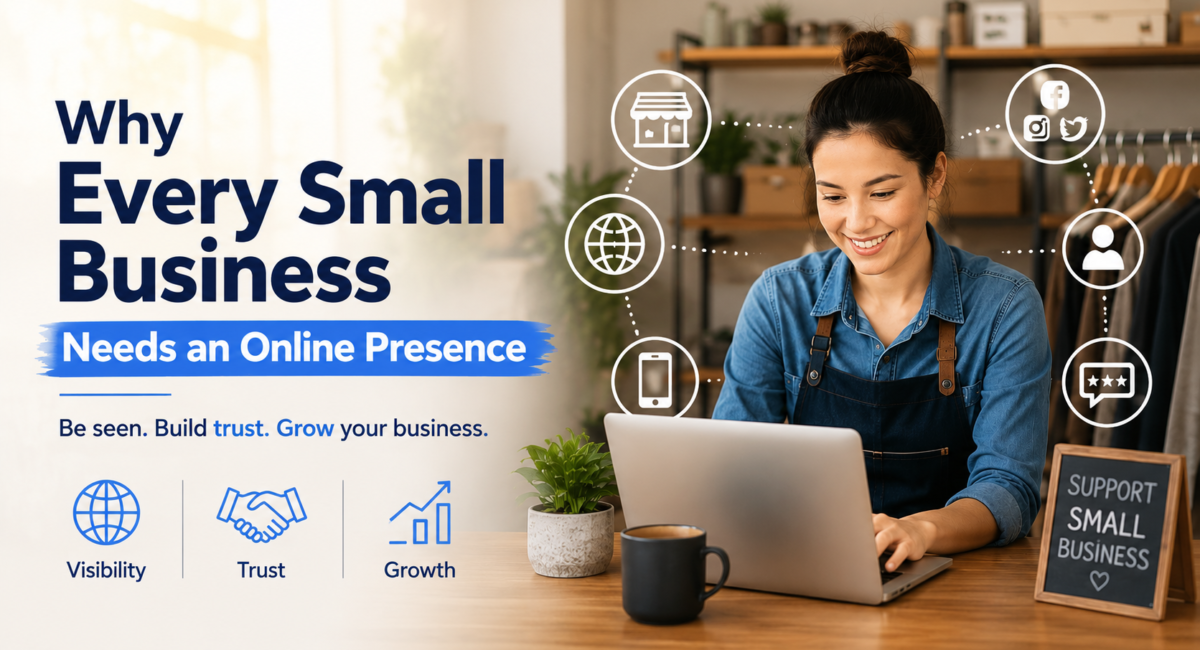
Why Every Small Business Needs an Online Presence
Introduction
Imagine two local businesses selling similar products in the same neighborhood. One has a simple but professional website, an active Google Business Profile, positive customer reviews, and regularly posts helpful content online. The other relies only on walk-in customers and word-of-mouth recommendations.
Now imagine someone searches online for the product both businesses sell. Which one is more likely to gain that customer’s trust?
The answer is obvious.
Today’s customers rarely make purchasing decisions without first checking the internet. Whether they need a nearby restaurant, a home renovation service, a clothing store, or a digital marketing agency, their journey almost always begins with a search engine. If your business doesn’t appear where customers are searching, you’re invisible to a large part of your potential market.
An online presence is no longer a luxury reserved for large companies. It has become one of the most important assets for businesses of every size. It helps people discover your brand, learn about your products or services, compare you with competitors, read customer reviews, and contact you whenever they’re ready to buy.
More importantly, your online presence works around the clock. While your physical store may close in the evening, your website, business listings, and social media profiles continue to attract visitors, answer questions, and generate leads.
This article explains why every small business needs an online presence, how it impacts growth, and the practical steps every business owner should take to build a strong digital foundation.
What Does an Online Presence Mean?
An online presence is the collection of digital platforms where customers can find information about your business.
It includes much more than just having a website.
A complete online presence typically consists of:
- A professional business website
- A Google Business Profile
- Business directory listings
- Social media profiles
- Customer reviews
- Blog articles
- Online contact information
- Maps and location details
- Email communication
- Videos and visual content
Each of these elements helps potential customers understand who you are, what you offer, and why they should trust your business.
Instead of acting independently, these channels work together to create a consistent and reliable brand image.
The Way Customers Buy Has Changed
Consumer behavior has changed dramatically over the last decade.
People no longer visit multiple stores before making a purchase. Instead, they research online first.
Before contacting a business, customers often:
- Search on Google
- Compare prices
- Read customer reviews
- Visit the company website
- Browse social media
- Look at photos
- Watch videos
- Read blog posts
- Check business hours
- View FAQs
Only after gathering enough information do they decide whether to make contact.
Businesses that provide useful and trustworthy information during this research stage have a significant advantage over those that don’t.
First Impressions Begin Online
Many business owners believe that first impressions happen when customers walk into their store.
In reality, first impressions usually happen online.
When someone searches for your business, they evaluate several factors within seconds.
They notice:
- Website quality
- Mobile responsiveness
- Customer reviews
- Business photos
- Contact information
- Social proof
- Professional branding
- Helpful content
A modern, informative online presence creates confidence.
An outdated website with missing information or no online presence at all may cause potential customers to choose a competitor instead.
Why an Online Presence Is Essential for Small Businesses
1. It Makes Your Business Easy to Find
The biggest advantage of having an online presence is visibility.
People search for businesses every day using phrases such as:
- Best bakery near me
- Affordable plumber
- Local web development company
- Home cleaning services
- Coffee shop nearby
- Digital marketing agency
If your business appears in these search results, you have an opportunity to gain a new customer.
If it doesn’t, someone else gets that opportunity.
Being discoverable online allows small businesses to compete with larger brands by reaching customers exactly when they need a product or service.
2. Customers Expect Businesses to Be Online
Modern consumers expect every legitimate business to have an online presence.
When people cannot find information about your business, they often wonder:
- Is this business still operating?
- Can I trust them?
- Are they professional?
- How do I contact them?
- What services do they offer?
- What do previous customers think?
Having accurate online information answers these questions before customers even ask.
This reduces uncertainty and encourages people to take the next step.
3. Your Website Becomes Your Digital Storefront
Think of your website as your digital shop.
Unlike a physical location, your website never closes.
It can:
- Explain your services
- Display pricing
- Showcase products
- Share testimonials
- Collect enquiries
- Generate appointments
- Answer common questions
- Publish educational content
A well-designed website gives visitors confidence that they are dealing with a professional business.
It also allows customers to learn about your company at their own pace.
4. Build Trust Before Customers Contact You
Trust is one of the biggest factors influencing buying decisions.
An online presence helps build credibility through:
Professional Branding
A clean logo, consistent colors, and quality design demonstrate professionalism.
Customer Reviews
Positive reviews reassure new customers that others have had good experiences.
Helpful Content
Publishing informative blog articles shows expertise rather than simply promoting products.
Real Business Information
Displaying your address, phone number, email, and business hours makes your company appear transparent and trustworthy.
Clear Policies
Refund policies, privacy policies, and contact details further strengthen customer confidence.
Trust isn’t built through advertising alone—it grows through transparency, consistency, and valuable information.
Search Engines Bring Customers with High Purchase Intent
One of the biggest advantages of being online is that customers often search when they’re already interested in buying.
For example, someone searching for:
- Emergency electrician
- Best dentist nearby
- Buy office furniture
- Website development services
- Local accountant
is already looking for a solution.
Unlike traditional advertising, search engine traffic reaches people at the exact moment they need help.
This makes search traffic highly valuable because visitors are often much closer to making a purchase.
Local SEO Helps Small Businesses Compete
Many business owners assume only national brands can dominate online.
That isn’t true.
Local SEO allows small businesses to compete within their own city or region.
By optimizing your online presence, you can appear in searches made by nearby customers looking for your products or services.
Important local SEO elements include:
- Accurate business information
- Consistent business name, address, and phone number
- Customer reviews
- Location pages
- Google Business Profile optimization
- Local citations
- Relevant local content
Even businesses with modest marketing budgets can generate steady leads by focusing on local search visibility.
Customers Research Before They Buy
Whether someone is spending $20 or $20,000, they usually conduct research first.
They compare businesses based on:
- Experience
- Reviews
- Expertise
- Pricing
- Customer service
- Portfolio
- Response time
- Reputation
Your online presence gives you the opportunity to answer these questions before your competitors do.
Businesses that educate customers through useful content often earn trust long before the first conversation takes place.
That trust frequently becomes the deciding factor when customers are ready to choose between multiple businesses.
An Online Presence Helps You Reach More Customers
A physical store is limited by its location and operating hours. Your potential customers are usually those who pass by your shop or hear about it through word of mouth.
An online presence removes these limitations.
Whether someone is searching from the next street or another city, they can discover your business, learn about your services, and contact you within minutes. Even if your business mainly serves a local area, being visible online increases the number of people who know your brand exists.
For example, a local bakery can attract customers searching for birthday cakes, wedding cakes, or fresh pastries nearby. A small accounting firm can receive inquiries from startups looking for tax advice. A web development agency can connect with businesses seeking a new website.
Every search is an opportunity to gain a customer.
Your Business Works 24/7
One of the biggest advantages of having an online presence is that it never sleeps.
Your website can continue to:
- Accept inquiries
- Display products and services
- Answer common questions
- Share pricing information
- Collect appointment requests
- Capture leads through contact forms
- Showcase customer testimonials
This means your business remains accessible even when your office is closed.
Many customers research businesses during evenings or weekends. If your information is available online, they can learn about your company whenever it is convenient for them.
Online Reviews Build Trust and Influence Decisions
People trust the experiences of other customers.
Before making a purchase, many consumers read reviews to understand the quality of a product or service.
Positive reviews can reassure potential customers that your business is reliable and professional. Even a few detailed, genuine reviews often have a greater impact than expensive advertising.
To make the most of customer feedback:
- Encourage satisfied customers to leave honest reviews.
- Respond politely to both positive and negative feedback.
- Thank customers for sharing their experiences.
- Address complaints professionally and offer solutions.
Businesses that actively manage their online reputation often appear more trustworthy and customer-focused.
Content Marketing Demonstrates Expertise
Simply telling customers that you are an expert is rarely enough.
Showing your knowledge through valuable content is much more effective.
Publishing blog articles, guides, FAQs, videos, or tutorials helps answer common customer questions before they make a purchase.
For example:
- A fitness trainer can publish workout tips.
- A florist can explain how to care for fresh flowers.
- A web development company can write about website security.
- A digital marketing agency can share SEO best practices.
This educational approach builds confidence and positions your business as a trusted source of information.
Over time, helpful content also attracts visitors through search engines, creating a steady stream of organic traffic.
Social Media Strengthens Customer Relationships
An online presence extends beyond your website.
Social media platforms allow businesses to interact directly with their audience.
You can use social media to:
- Share updates
- Announce new products
- Promote offers
- Answer customer questions
- Highlight success stories
- Showcase behind-the-scenes content
- Celebrate company milestones
Regular interaction helps keep your business in customers’ minds and encourages long-term loyalty.
Instead of focusing only on selling, successful businesses use social media to educate, entertain, and engage their audience.
Digital Marketing Becomes More Effective
Without an online presence, digital marketing has little foundation.
Imagine running advertisements that direct visitors to a business with no website or outdated information. Many potential customers will leave without taking action.
A strong online presence supports multiple marketing channels, including:
Search Engine Optimization (SEO)
SEO helps your website appear in search results when customers are looking for products or services related to your business.
Email Marketing
Email newsletters allow you to stay connected with existing customers by sharing updates, offers, and useful information.
Social Media Marketing
Regular posts help increase visibility and encourage engagement.
Pay-Per-Click Advertising
Paid advertising can quickly attract targeted visitors to your website or landing pages.
Content Marketing
Educational articles continue attracting traffic long after they are published.
When these channels work together, they create a consistent customer journey from discovery to purchase.
Better Customer Service Through Digital Channels
Customers appreciate businesses that are easy to contact.
An online presence makes communication simple by providing:
- Contact forms
- Email addresses
- Phone numbers
- Live chat
- Frequently Asked Questions
- Social media messaging
Quick responses improve customer satisfaction and increase the likelihood of converting inquiries into sales.
Providing clear answers online also reduces repetitive customer questions, saving time for both your team and your customers.
Understand Customer Behavior with Analytics
Unlike traditional marketing, online platforms provide valuable insights into customer behavior.
Website analytics can show:
- Which pages receive the most visitors
- How people found your website
- Which content performs best
- How long visitors stay
- What devices they use
- Which pages generate inquiries
These insights help businesses make informed decisions instead of relying on guesswork.
Over time, analyzing customer behavior allows you to improve both your website and your marketing strategy.
Competing with Larger Businesses
Many small business owners believe they cannot compete with larger companies.
However, the internet has created opportunities for businesses of all sizes.
Customers often prefer local businesses because they offer:
- Personalized service
- Faster communication
- Community knowledge
- Flexible solutions
- Strong customer relationships
By maintaining a professional website, publishing useful content, and optimizing for local search, small businesses can compete effectively with much larger competitors.
Success online is determined by relevance, trust, and user experience—not just company size.
Cost-Effective Marketing
Traditional advertising methods such as newspapers, radio, or billboards can be expensive and difficult to measure.
Digital marketing supported by a strong online presence offers several advantages:
- Lower costs
- Better targeting
- Measurable results
- Flexible budgets
- Long-term visibility
For example, a helpful blog article can continue attracting visitors for months or even years after it is published.
This makes content marketing one of the most cost-effective strategies for small businesses.
Common Mistakes Small Businesses Should Avoid
Even businesses that have an online presence sometimes miss important opportunities.
Avoid these common mistakes:
Ignoring Mobile Users
Most people browse websites on smartphones. Ensure your website loads quickly and works well on mobile devices.
Outdated Information
Keep your business hours, contact details, pricing, and services up to date.
Inconsistent Business Information
Use the same business name, address, and phone number across all online platforms.
Neglecting Customer Reviews
Respond professionally to customer feedback and encourage satisfied customers to share their experiences.
Publishing Low-Quality Content
Focus on creating original, informative content that genuinely helps your audience rather than writing only for search engines.
Slow Website Speed
Visitors often leave websites that take too long to load. Optimizing images, using reliable hosting, and reducing unnecessary code can improve performance.
Weak Calls to Action
Every page should guide visitors toward the next step, whether it’s contacting your business, requesting a quote, booking a service, or making a purchase.
Practical Steps to Build a Strong Online Presence
If you’re starting from scratch, follow these steps:
- Create a professional, mobile-friendly website.
- Claim and optimize your Google Business Profile.
- Keep your business information consistent across all online directories.
- Publish helpful blog articles regularly.
- Encourage genuine customer reviews.
- Stay active on the social media platforms your audience uses.
- Optimize your website for search engines.
- Monitor website performance with analytics tools.
- Update your content regularly to keep it accurate and relevant.
- Focus on providing value before promoting your products or services.
Building an online presence is an ongoing process, but consistent effort leads to long-term growth and stronger customer relationships.
The Future of Small Business Is Digital
Technology continues to change how people discover, compare, and buy products and services. Voice search, artificial intelligence, mobile commerce, and local search are making it even easier for customers to find businesses online.
Consumers now expect businesses to provide quick answers, transparent information, and a seamless digital experience. They want to browse products, read reviews, compare prices, and contact a business without unnecessary effort.
Businesses that embrace these changes are better positioned to attract new customers and adapt to evolving market trends. Those that delay building their online presence may find it increasingly difficult to compete.
An online presence is not about following a trend—it is about meeting customer expectations and preparing your business for the future.
Why Google Values Experience, Expertise, Authoritativeness, and Trustworthiness (E-E-A-T)
Search engines aim to provide users with accurate, reliable, and helpful information. This is where Google’s E-E-A-T principles become important.
Experience
Content should reflect practical knowledge and real-world understanding. Sharing examples, customer stories, or firsthand insights helps readers trust your advice.
Expertise
Demonstrate a deep understanding of your industry by answering common questions clearly and accurately. Well-researched, informative content performs better than articles written only to target keywords.
Authoritativeness
Authority is built over time through consistent, high-quality content, positive customer reviews, reputable backlinks, and recognition within your industry.
Trustworthiness
Trust is the foundation of every successful business. Display accurate contact information, maintain transparent policies, secure your website with HTTPS, and ensure your content is factually correct and regularly updated.
By focusing on these principles, you create content that benefits both users and search engines.
Signs Your Business Needs a Stronger Online Presence
Many business owners believe they already have an online presence simply because they created a social media page years ago. However, an effective online presence requires consistent maintenance and optimization.
You may need to improve your digital presence if:
- Your website receives very little traffic.
- Customers say they couldn’t find your business online.
- Your competitors appear above you in search results.
- Your business has very few online reviews.
- Your contact information differs across websites.
- Your website is slow or not mobile-friendly.
- You rarely publish new content.
- Your business lacks a Google Business Profile or has incomplete information.
Recognizing these issues early allows you to make improvements before they affect customer acquisition.
Building Long-Term Success Online
A successful online presence is not built overnight. It requires consistency, patience, and a commitment to providing value.
Instead of chasing quick wins, focus on sustainable practices:
- Publish high-quality content regularly.
- Keep your business information accurate.
- Update older content with fresh information.
- Encourage authentic customer feedback.
- Improve website speed and usability.
- Earn backlinks from reputable websites.
- Monitor performance using analytics.
- Continue learning about changing search trends.
Small improvements made consistently often produce stronger long-term results than occasional large marketing campaigns.
Frequently Asked Questions
Does every small business need a website?
Yes. Even if you primarily attract local customers, a professional website acts as your digital storefront. It helps potential customers learn about your services, view your contact information, and decide whether to do business with you.
Is social media enough without a website?
No. Social media is valuable for engagement, but you don’t own those platforms. Algorithms can change, accounts can be restricted, and information may be difficult to organize. A website gives you full control over your online presence and serves as the central hub for your business.
How can a small business appear higher in Google search results?
Improving search visibility involves several factors, including creating helpful content, optimizing your website for SEO, maintaining accurate business information, earning quality backlinks, collecting customer reviews, and ensuring a fast, mobile-friendly user experience.
How often should I update my website?
Review your website regularly and update it whenever your services, pricing, business hours, or contact information change. Publishing fresh blog content each month also helps keep your website active and relevant.
What is the biggest advantage of having an online presence?
The greatest advantage is visibility. A strong online presence allows customers to find your business when they are actively searching for the products or services you offer. It also builds trust, strengthens your reputation, and supports long-term business growth.
Conclusion
The way people discover businesses has changed permanently. Customers no longer rely solely on newspaper advertisements, flyers, or recommendations from friends. They turn to search engines, online reviews, business directories, and social media to help them make informed decisions.
For small businesses, establishing a strong online presence is no longer optional—it is an essential part of remaining competitive. A professional website, accurate business information, valuable content, positive customer reviews, and consistent branding work together to create trust and improve visibility.
While building an online presence takes time, the long-term benefits far outweigh the effort. Increased brand awareness, improved customer trust, better search engine visibility, and more opportunities to generate leads all contribute to sustainable business growth.
Instead of viewing your online presence as a marketing expense, think of it as a long-term investment in your business’s future. Every blog post you publish, every customer review you earn, and every improvement you make to your website strengthens your digital foundation.
Businesses that consistently provide helpful information, maintain transparency, and focus on delivering value are far more likely to build lasting relationships with customers and achieve steady growth in an increasingly digital world.
Leave a Comment