
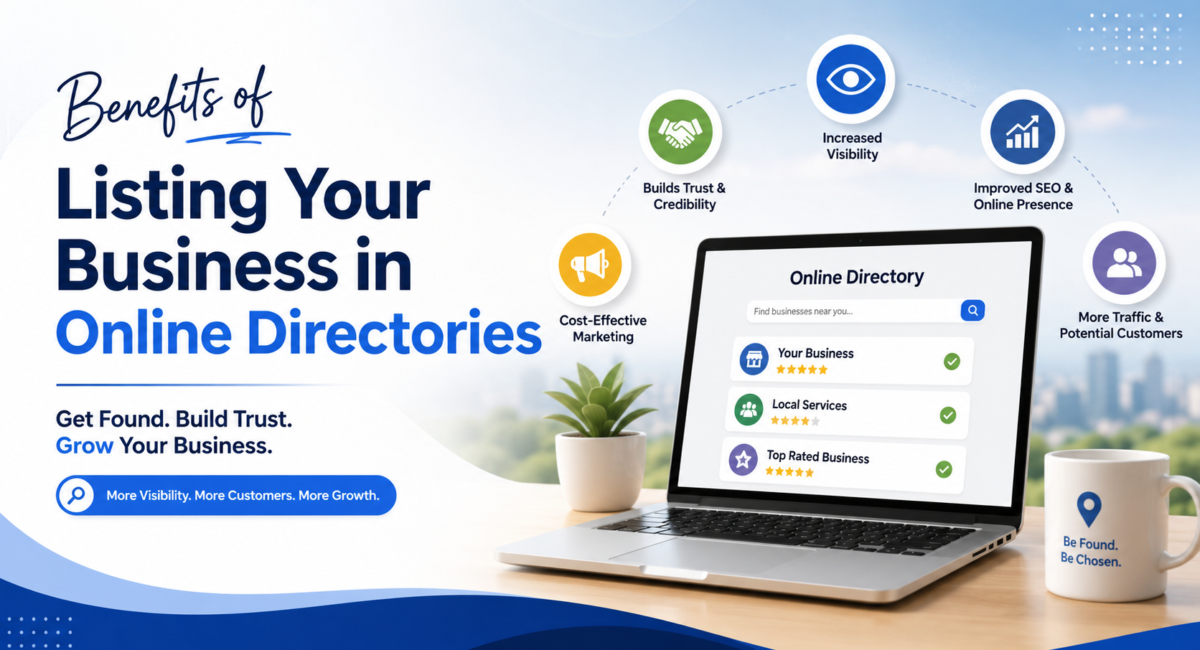
Why Your Business Still Needs to Be Listed in Online Directories
There’s this weird assumption that online directories are a 2010 thing. That they’re outdated. That Google has made them irrelevant. I hear this from business owners all the time, and honestly, it’s one of the more expensive misconceptions floating around in digital marketing.
The truth is almost the opposite. Directories matter more now than they did five years ago just for different reasons than most people think.
What Exactly Is an Online Business Directory?
An online directory is simply a platform where businesses get listed by category, location, or industry Google Business Profile, Justdial, Sulekha, Yelp, IndiaMart, Bing Places, Facebook Business, and easily a hundred more depending on your field.
Some are free. Some charge. Some are general-purpose, some are hyper-specific to an industry. A restaurant on Zomato and a B2B company on Clutch are both directory listings just different contexts.
What connects them is simple: they exist to help people find businesses. And when people are looking, you want to be found.
The Real Benefits Without the Fluff
1. Local SEO Gets Dramatically Stronger With Directory Listings
If you’ve ever wondered why some local businesses consistently show up in the “map pack” those three results with the map at the top of Google a big part of the answer is consistent directory presence.
Google doesn’t just look at your website to decide if you’re a real, trustworthy local business. It looks at how consistently your business information appears across the web. Name, address, phone number, what SEOs call NAP data. When that information matches across dozens of directories, Google gets more confident that you’re legitimate and ranks you accordingly.
This is called citation building. It’s not glamorous. Tedious, actually. But it works.
A business with 40 consistent citations in relevant directories will almost always outrank a competitor with better website design but zero directory presence all else being equal.
2. You Get Backlinks That Actually Help Your Domain Authority
Not every backlink pulls equal weight, and that’s fine. A listing on Justdial or Sulekha tells Google something basic but important this business exists, it operates in this area, real platforms are acknowledging it. That’s enough to move the needle.
For businesses in Kolkata or any mid-size Indian city, this is actually good news. Local keyword competition is still beatable. You don’t need 500 links. Thirty to forty from platforms Google already respects will get you further than most people realize.
3. Referral Traffic That Converts Better Than Most Paid Ads
Directory visitors aren’t browsing aimlessly. Someone who found you on Justdial was already looking for what you sell they just needed to pick a business. That’s a very different mindset from someone who saw your display ad while reading the news. The intent gap between the two is massive, and it shows in how often directory visitors actually contact you.
Referral traffic from directories tends to have lower bounce rates and higher inquiry rates compared to cold ad traffic. Not the highest volume, but the quality makes up for it.
4. Your Business Shows Up in Voice Search and AI Assistants
This is the part people genuinely underestimate right now.
When someone asks Siri or Google Assistant “find a digital marketing institute near me” the answer usually comes from a business profile or directory listing, not from crawling your website. Structured data in directories hours, address, category, reviews is exactly what these tools pull from.
With voice search growing and AI-generated search results becoming more common, businesses without directory listings simply won’t appear. It’s not a penalty. You just don’t exist in that context.
5. Reviews on Directories Build Trust Before Anyone Contacts You
A business with 47 Google reviews and a 4.3-star rating looks very different from one with zero reviews and no profile. That much is obvious. But it goes deeper.
Google explicitly uses review quantity, recency, and response rate as local ranking factors. A business that actively manages its directory listings responding to reviews, updating hours, adding photos tends to outrank one that created a listing two years ago and never came back.
Reviews on third-party directories also work independently of Google. Sulekha reviews influence Sulekha rankings. A Clutch profile with detailed client feedback is often the deciding factor in a B2B buying decision. These platforms have their own ecosystems.
6. You Get Found on Platforms Where Google Doesn’t Dominate
Google is massive, but it doesn’t own every search context.
Someone looking for a vendor on IndiaMart is searching on IndiaMart not Google. Someone checking restaurant options on Zomato is on Zomato. Someone comparing institutes on Shiksha or Careers360 is using those platforms’ own search functions entirely.
If you’re not listed there, you don’t exist for those users. No amount of Google SEO fixes that.
This matters especially for education businesses, B2B companies, and service providers where category-specific directories have built loyal, high-intent audiences.
7. Directories Help Build Brand Familiarity Across the Web
Every time your business name, address, and description appears the same way across another platform, it adds one more data point Google uses to confirm you’re real. And separately, people who see your name in three or four places before visiting your site tend to trust it more when they finally do. That kind of passive familiarity is hard to manufacture directory listings build it quietly over time.
There’s a concept in marketing called the “rule of seven.” Most people need multiple exposures to a brand before they act. Directories create those touchpoints without any ongoing effort on your end.
Common Mistakes Businesses Make With Directory Listings
The benefits above only apply if the listings are done right. Most aren’t.
Inconsistent NAP Information
If your address reads “12, Park Street, Kolkata” on Google and “12 Park St., Kolkata – 700016” on Justdial, search engines don’t automatically assume they’re the same place. They see conflicting data and trust you less. Fix this before creating any new listings pick one format and use it everywhere.
Creating Listings and Abandoning Them
A listing you created two years ago and never touched again can genuinely hurt you. Wrong number, outdated hours, no photos visitors assume you’ve either moved or shut down. Check your existing listings a few times a year at minimum. It takes less time than you think.
Ignoring Niche Directories
Most businesses focus only on Google Business Profile and maybe Justdial. But depending on your industry, niche directories drive better-converting traffic. A digital marketing training institute should be on Shiksha and Careers360. A law firm should be on LawRato. A design studio should be on Clutch and DesignRush. General directories get volume niche ones get intent.
Not Using All Available Fields
Every directory gives you space for a description, categories, photos, business hours, website URL, and sometimes videos. Most businesses fill in maybe 30% of that. Incomplete profiles rank lower within the directory’s own search and look less trustworthy to real visitors.
Which Directories Should You Prioritize?
Depends on your business type, but here’s a reasonable starting point for most Indian businesses:
For local visibility: Google Business Profile, Justdial, Sulekha, Bing Places, Facebook Business
For education businesses: Shiksha, Careers360, CollegeDekho, CourseReport (if international courses)
For B2B: IndiaMart, TradeIndia, Clutch, G2
For restaurants and food: Zomato, Swiggy, Google Business Profile
For service businesses: Sulekha, Urban Company, and any local city-specific directory in your area
Start with platforms where your actual audience searches not just the ones with the most general traffic.
Final Thought
Directory listings aren’t exciting. Nobody builds a career around them. But they’re one of those consistent, unsexy things that compounds over time — like writing helpful content or following up with leads.
A business that spends two or three hours setting up and maintaining quality directory listings will pull ahead of competitors who skip this step. Usually within four to six months. Not because it’s magic – because most people don’t bother doing it properly, so the bar is genuinely low.
That’s the opportunity right now. The basics, done well.
Leave a Comment